Does giving after a win make discipline stick? Our honest hypothesis
YouSens rests on an idea we cannot yet prove, that turning a personal win into a small act of good makes the habit mean more. Here is the science we lean on, where it runs out, and why we call it a hypothesis.
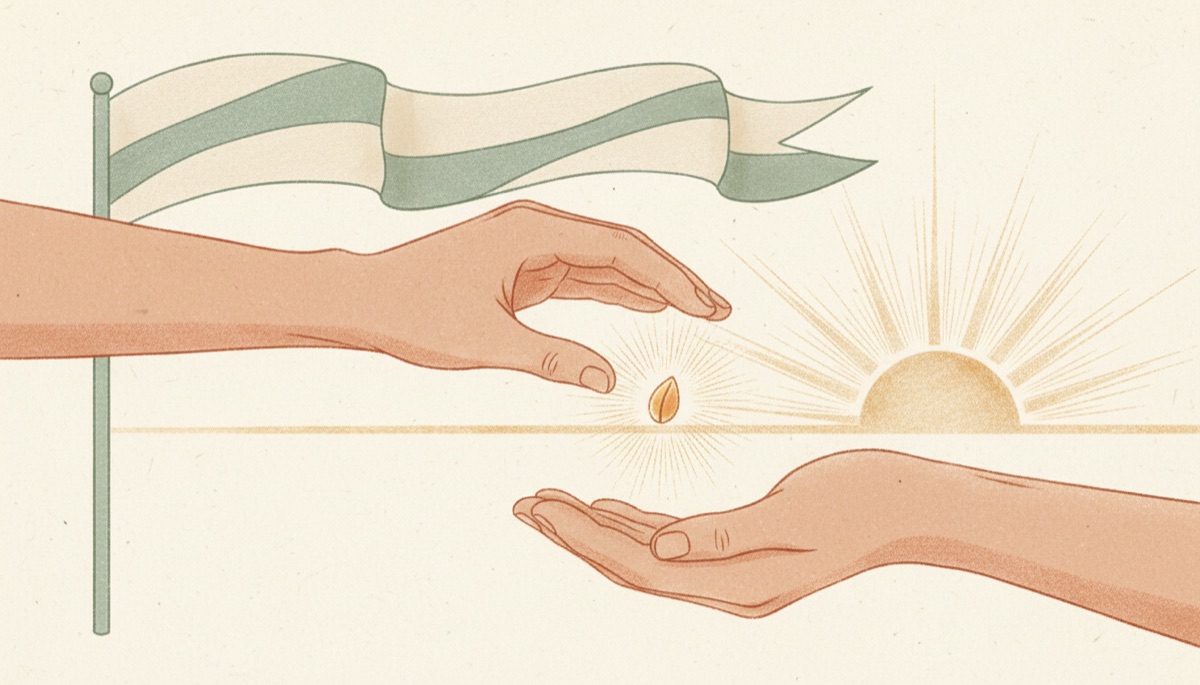
We want to be straight about this one. The core idea of YouSens, that finishing a habit and then giving makes discipline stick better, does not have a clean study behind it. It is a hypothesis we are testing in the open, not a finding we are selling.
What the science does support
Giving feels good in a measurable way. Harbaugh, 2007, in Science, put people in a scanner. Voluntary transfers to a cause lit up the brain’s reward regions, the ventral striatum, more than mandatory ones did. Choosing to give is its own reward.
Dunn, Aknin and Norton, 2008, in Science, found that people who spent a small sum on others reported more happiness than those who spent it on themselves. Honest caveat: that first study was small, 46 people, and later replications were mixed, so we hold it loosely.
Separately, commitment devices work. Tying a goal to a stake or a consequence you set yourself improves follow-through, which is the research behind services like StickK. Meaning can act as a gentler kind of stake.
Where the science runs out
Here is the gap. No one has run a clean trial on our exact loop, finish a habit, then give, and measured whether the habit lasts longer because of it. The niche is empty. So we will not claim it as a fact, and you should be wary of any app that would.
We would rather tell you it is a hypothesis than dress a hope up as a result.
Why we still built it this way
Two reasons. The reward science says a voluntary gift is a genuine positive, not a guilt tax. And a habit tied to something larger than yourself has a reason to survive the boring middle, the stretch where novelty is gone and the finish is not close. Giving is always optional, always after a win, never a price of entry. Saying no is completely fine.
We will publish what we learn from our own data. If the loop does not help people keep habits, we will say so plainly. An honest no is a useful answer too.
Key takeaways
- The core YouSens loop, win then give, has no direct study yet. We call it a hypothesis.
- Science supports pieces of it: voluntary giving activates reward regions (Harbaugh, 2007).
- Prosocial spending links to happiness (Dunn, 2008), but that evidence is modest.
- Giving in YouSens is always optional and always after a win, never required.
Questions
Is it proven that giving makes habits stick?
No. We are honest that this is a hypothesis. The supporting science covers nearby effects, not our exact loop, which we are testing openly.
Do I have to give anything to use YouSens?
No. The app is free, giving is always optional, always after you reach your goal, and saying no is completely fine.
Sources
- Harbaugh, W.T., Mayr, U., Burghart, D.R. (2007). Neural responses to taxation and voluntary giving. Science, 316.
- Dunn, E., Aknin, L., Norton, M. (2008). Spending money on others promotes happiness. Science, 319.
- Aknin, L. et al. (2022). Registered replication on prosocial spending. PLOS One.